
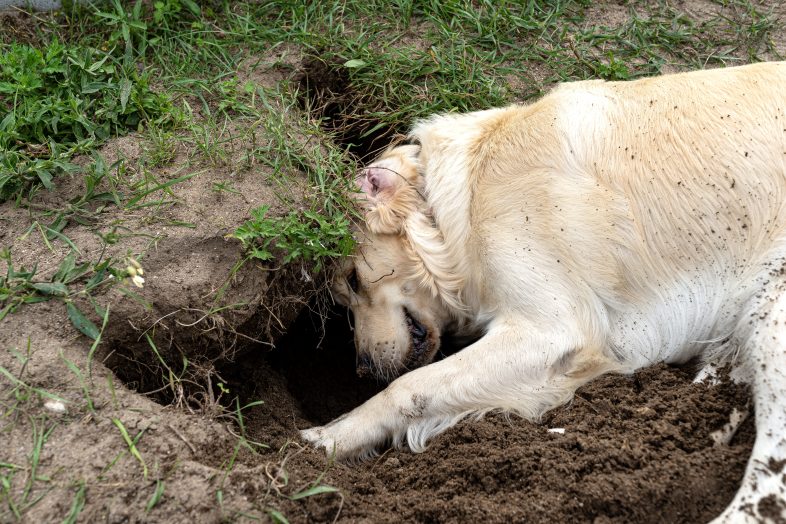
You know the scene.
You let the dog outside. You answer a message, make a cup of coffee, wander back to the window and discover that somebody has apparently begun preparations for an underground swimming pool.
Your freshly planted flowers are sideways. There is soil everywhere. Your dog is standing in the middle of it looking extremely pleased with the morning's work.
It's tempting to assume your dog knows perfectly well that digging is forbidden and has decided to do it anyway.
Dogs don't really work like that.
Digging is part of the normal behavioural repertoire of domestic dogs. Veterinary behaviour literature has long recognised that dogs may dig for a variety of perfectly understandable reasons, even though those reasons are not always compatible with an immaculate garden.
The better question isn't simply:
“How do I stop my dog from digging?”
It is:
“What is my dog getting out of digging?”
Once you know the answer to that, solving the problem becomes much easier.
First things first: is digging normal for dogs?
Yes. Digging can be completely normal.
Dogs did not arrive in our homes as blank slates. Their behaviour has been shaped by evolution, domestication, selective breeding, learning and their individual experiences.
For the ancestors of modern dogs, digging could be useful. It could help uncover prey, create a sheltered resting place, store food or gain access to somewhere otherwise unreachable.
Humans later selectively bred some dogs specifically for work in which digging and pursuing animals underground were useful traits. Terriers are an obvious example.
That does not mean every Terrier is destined to destroy the garden, or that a Labrador, Spaniel, mixed-breed dog or Chihuahua won't dig.
A large 2022 study published in Science, involving behavioural information from more than 18,000 dogs, found considerable behavioural variation between individual dogs. Breed ancestry contributed to behaviour, but breed alone was a relatively poor predictor of how an individual dog would behave.
Why does my dog dig holes?
There is no single answer.
Two dogs can dig almost identical holes for completely different reasons. Where your dog digs, when they dig and what happens immediately before and afterwards can tell you much more than the hole itself.
1. There may be something living under your lawn
If your dog repeatedly attacks one particular patch of ground, they may know something you don't.
Dogs have an extraordinary sense of smell and can detect sounds and movement that humans may completely miss. Veterinary behaviour sources note that dogs may dig because they have detected rodents, insects or other small animals beneath the ground.
Watch your dog before the digging starts.
Are they intensely sniffing one spot? Tilting their head? Listening? Pouncing at the ground and then digging rapidly?
If so, you might have less of a dog problem and more of an underground visitor problem.
Simply punishing the digging doesn't remove the reason for it. If something continues moving and smelling interesting under the lawn, your dog still has a very strong reason to investigate.
2. Your dog may be trying to cool down
Sometimes a dog digs a broad, shallow hollow and then promptly lies down in it.
This isn't necessarily random.
The soil beneath the sun-warmed surface can be cooler. Digging away the warmer top layer gives the dog access to cooler earth against the belly and body.
Veterinary behaviour references often mention this in thick-coated northern breeds such as Huskies and Malamutes, although any dog may attempt it when conditions are hot enough.
3. Your dog has opened an underground savings account
Some dogs bury things.
Bones. Treats. Chews. Toys.
Occasionally something belonging to you that you were rather hoping to see again before Christmas.
This behaviour is known as caching. A valuable resource can effectively be stored for later use.
A dog may dig a small hole, deposit a chew or toy, push soil over it with the nose and return later to retrieve it.
If your dog's favourite possessions keep disappearing shortly before new holes appear, the case may be solved.
4. Digging can simply be enjoyable
This explanation is easily overlooked.
Digging can feel good.
There are smells in the soil, roots to pull at, textures under the paws, insects moving around and an enormous amount of sensory information that means far more to a dog's nose than it does to ours.
Research into canine environmental enrichment supports giving dogs opportunities to perform appropriate natural behaviours.
A particularly relevant example comes from welfare work involving dogs at the Waltham Petcare Science Institute. Researchers described providing dogs with dedicated sandpits where they were allowed to dig. Once appropriate digging areas were introduced, unwanted digging in grass areas was reduced.
That's useful because it changes the question from:
“How do I stop this behaviour entirely?”
to:
“Can I give this behaviour somewhere acceptable to happen?”
A sandpit or dedicated section of loose soil can be very effective for dogs that genuinely enjoy digging. You can even bury toys or treats in the approved area at first so that the legal excavation site becomes more rewarding than the rose bed.
5. Your dog may be trying to escape
Digging directly underneath a fence, gate or wall deserves special attention.
Sometimes the explanation is simple: something interesting is on the other side.
That might be another dog, people walking past, wildlife, a familiar route or an opportunity to explore.
An intact dog may also be strongly motivated to reach another dog for mating.
But repeated escape attempts can sometimes be associated with fear, frustration or separation-related distress.
Research into separation-related problems in dogs recognises destructive behaviour and attempts to escape amongst the signs that can occur in affected animals.
That does not mean that every dog digging under a gate has separation anxiety. Behaviour should never be diagnosed from one sign alone.
A camera can be extremely useful.
Record your dog when nobody is home. If digging happens mainly after you leave and is accompanied by persistent barking, whining, pacing, panting, salivation, destruction around exits or frantic escape attempts, speak to an appropriately qualified professional.
6. Pregnant dogs may dig as part of nesting behaviour
A pregnant female dog may scratch, dig and seek secluded areas as she approaches whelping.
If your dog may be pregnant and suddenly begins behaving as though she intends to convert the area beneath the garden shed into a maternity ward, speak to your veterinarian and make sure an appropriate whelping area is available.
Is my dog digging because they're bored?
Possibly.
But “boredom” has become a catch-all explanation for almost every inconvenient thing dogs do.
A better question is whether your dog's physical, social and behavioural needs are being met.
A large garden does not automatically provide enrichment. Leaving a dog alone in a garden all day is a little like leaving a person alone in an empty sports field and assuming the size of the field will keep them entertained.
Dogs benefit from opportunities to sniff, explore, play, chew, solve simple problems, interact socially and learn.
Research into environmental enrichment has shown measurable changes in canine behaviour, including increases in relaxation-related behaviour and reductions in some behavioural indicators associated with stress.
If a dog spends long periods with very little meaningful activity, digging may become one of the most interesting options available.
Unfortunately, your lawn, flower beds and irrigation pipes then become part of the entertainment package.
Look at the pattern, not just the hole
A little detective work can often reveal why the behaviour is happening.
| What you're seeing | What it may suggest |
|---|---|
| Repeated digging in one particular area with lots of sniffing or listening | Your dog may be detecting rodents, insects or another animal underground. |
| A wide, shallow hole followed by lying in it | Your dog may be trying to reach cooler soil or create a comfortable resting place. |
| Toys, bones or chews disappearing into holes | Your dog is probably caching valuable items for later. |
| Digging increases during long periods with little interaction or activity | Lack of suitable stimulation or enrichment may be contributing. |
| Digging directly underneath fences or gates | Your dog may be trying to reach something outside, explore, escape or respond to frustration or distress. |
| Frantic digging near exits mainly when left alone | A separation-related problem may need to be investigated. |
| A pregnant female scratching or digging in secluded places | Nesting behaviour may be occurring as whelping approaches. |
| Relaxed, enthusiastic digging whenever loose soil is available | Your dog may simply enjoy digging. |
These are clues rather than diagnoses. Behaviour always needs to be interpreted in context.
How do I stop my dog from digging?
The answer depends on why your dog is digging.
This is also why punishment is usually such a poor solution.
If an animal is moving underneath the lawn, punishment doesn't remove the animal.
If the dog is overheating, punishment doesn't make the environment cooler.
If the dog is anxious about being left alone, punishment does nothing to resolve the anxiety and may make the situation worse.
And if digging itself is enjoyable, the dog may simply learn not to do it while you're standing nearby.
Give your dog an appropriate digging area
For dogs that genuinely enjoy digging, a designated sandpit or section of loose soil can work extremely well.
Encourage use of the area by burying safe toys or treats there. Reward the dog for choosing the correct place.
Protect areas that genuinely matter
Management is not cheating.
If there are areas where digging would be dangerous or particularly destructive, restrict unsupervised access while you work on the underlying cause.
This is especially important around fencing, irrigation systems, toxic plants or places where a dog could injure themselves.
Increase appropriate enrichment
If your dog has very little to do, provide more meaningful activity rather than simply trying to suppress the activity they invented for themselves.
Useful options can include:
- sniffing walks where the dog is allowed time to investigate smells;
- short positive-reinforcement training sessions;
- food-search and scent games;
- safe chew items;
- play appropriate to the individual dog;
- social interaction; and
- opportunities to explore new environments safely.
Deal with underground pests humanely
If rodents or other animals are attracting your dog to one area, address the underlying problem rather than repeatedly punishing the dog for noticing it.
Use humane, animal-safe pest management and avoid poisons or traps that could harm your dog or other animals.
Deal with escape digging properly
If your dog is digging under a boundary, treat it as a safety issue.
Prevent unsupervised access to the vulnerable section while you determine what is motivating the escape behaviour. Simply filling the hole every afternoon is unlikely to solve anything if the dog's motivation remains unchanged.
When should digging concern me?
An occasional hole made by an otherwise relaxed, healthy dog is very different from behaviour that is frantic, repetitive or associated with distress.
Professional assessment becomes particularly important when:
- digging appears suddenly and represents a major change in behaviour;
- the behaviour becomes unusually intense or repetitive;
- your dog injures their paws, nails, nose or mouth while digging;
- your dog repeatedly escapes or nearly escapes from the property;
- digging appears closely connected to being left alone;
- the dog shows panic, pacing, vocalising or destruction at the same time;
- the dog appears physically uncomfortable or unwell; or
- you cannot identify or safely manage the reason for the behaviour.
Need help working out why your dog is digging?
If the behaviour is persistent, difficult to manage or appears connected to anxiety, fear, frustration or another behavioural concern, you do not have to guess your way through it. PPC-SA maintains a directory of registered companion-animal professionals in South Africa, including Behaviour Consultants and Trainers.
A Behaviour Consultant can help assess the reason behind persistent or concerning digging and develop an appropriate management and behaviour plan. A registered Trainer may also assist with practical training, enrichment and everyday management where the problem is not driven by a clinical or serious behavioural concern.
Find a PPC-SA professionalFrequently asked questions about dogs digging
Why has my dog suddenly started digging holes?
A sudden change is worth investigating. Something new may be attracting your dog underground, weather conditions may have changed, your dog's routine may have changed, or the digging may be associated with stress, escape behaviour or another physical or behavioural issue. Look at what else changed at the same time. If the behaviour is dramatic, unexplained or accompanied by other changes, speak to your veterinarian or a qualified behaviour professional.
Do dogs dig because they are bored?
Some do, particularly if they have few other opportunities for activity, exploration or stimulation. However, boredom should not automatically be blamed for every hole. Dogs also dig while hunting underground animals, cooling themselves, caching objects, escaping, nesting and simply because digging can be rewarding.
Should I fill in my dog's holes immediately?
You can certainly repair the garden, but filling a hole does not remove the motivation that caused it. If the dog is hunting something underground or trying to escape, the hole may simply reappear. Work out why the digging is occurring and address that at the same time.
Will giving my dog a sandpit encourage more digging?
Not necessarily. A designated digging area can give the behaviour an appropriate outlet and make it easier to teach the dog where digging is permitted. Research and canine welfare practice have described reductions in unwanted digging when dogs are given suitable areas where the behaviour is allowed.
Why does my dog dig and then lie in the hole?
The dog may be creating a comfortable resting hollow or trying to reach cooler soil beneath the surface. If the weather is warm, make sure your dog also has adequate shade, drinking water and a genuinely cool resting area.
Why does my dog bury bones and toys?
This is known as caching. Dogs may bury valued resources and return to them later. It is a recognised form of normal canine behaviour.
Should I punish my dog for digging?
Punishment does not address the reason for the behaviour and can be particularly inappropriate when digging is related to fear or separation-related distress. Management, environmental changes, enrichment and reinforcing appropriate alternative behaviour are generally more useful approaches.
References & further reading
- Odendaal JSJ. An ethological approach to the problem of dogs digging holes . Applied Animal Behaviour Science. 1997;52(3–4):299–305. DOI: 10.1016/S0168-1591(96)01130-6.
- Horwitz D, Landsberg G. Dogs and Destructive Digging . VCA Animal Hospitals.
- Merck Veterinary Manual. Behavior Problems of Dogs . Veterinary behaviour reference.
- Morrill K, et al. Ancestry-inclusive dog genomics challenges popular breed stereotypes . Science. 2022;376(6592):eabk0639.
- Prescott MJ, et al. Challenges and Solutions Surrounding Environmental Enrichment for Dogs and Cats in a Scientific Environment . Animals. 2021;11(10):2958.
- Hunt RL, et al. Effects of Environmental Enrichment on Dog Behaviour: Pilot Study . Animals. 2022;12(2):141. DOI: 10.3390/ani12020141.
- Sargisson RJ. Canine separation anxiety: strategies for treatment and management . Veterinary Medicine: Research and Reports. 2014;5:143–151.
- de Assis LS, et al. Developing Diagnostic Frameworks in Veterinary Behavioral Medicine: Disambiguating Separation Related Problems in Dogs . Frontiers in Veterinary Science. 2020;6:499.
- Pet Professional Council of South Africa. PPC-SA Members Listings . Directory of registered professionals in South Africa's non-clinical companion-animal sector.
This article is intended for education and general information and does not replace veterinary diagnosis, treatment or individual behavioural assessment. Digging can be completely normal, but sudden or extreme behavioural changes can sometimes occur alongside physical or emotional problems. If your dog is injured, unwell or showing a significant unexplained change in behaviour, contact a veterinarian. PPC-SA operates within South Africa's non-clinical companion-animal sector.